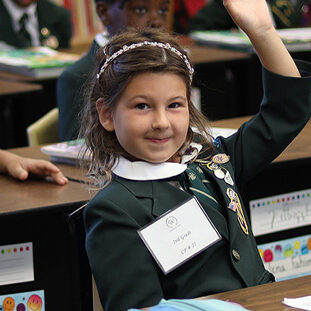

Curriculum Objectives Second Grade
Language Arts
- Phonics: short vowels, blending, dipthongs, diagraphs, vowels, blends
- Spelling: plurals, syllabication, rules
- Reading comprehension: vocabulary building, facts, paraphrasing, context, sequence, summarization, inference
- Word analysis skills
- Vocabulary skills: homophones, antonyms and synonyms, prefixes and suffixes, context clues, use of dictionary
- Proofreading
- Handwriting
- Grammar and usage: nouns, verbs, pronouns, capitalization, punctuation
- Critical thinking
- Listening skills
- Speaking skills
- Composition skills
- Creative writing
- Reports and letters
- Independent reading
- Junior Great Books
- Summer workbook
- Summer reading
Mathematics
- Numeration: sequence through 10,000; writing to 100
- Measurement: weight, length, capacity
- Geometry
- Operations: 2-, 3-, and 4-digit addition and subtraction, multiplication, division
- Fractions
- Relations
- Patterns
- Functions
- Money
- Clocks: digital and analog
- Calendars
- Problem solving
- Place value: regrouping, standard form
- Conversion of metric units
- Decimals: comparing, addition, and subtraction
- Rounding numbers
- Summer workbook
Social Studies
- American holidays
- American flag
- Pledge of Allegiance
- Native Americans
- Pilgrim pioneers from England
- English pioneers
- Columbus
- Other explorers
- Colonial America
Science
- Plants
- Animals
- Living together: populations and communities
- Nutrition and health
- Earth science
- Space science
- Matter
- Work and machines
- Frequent hands-on activities/lab
Geography
- Globe
- Four hemispheres
- Cardinal directions/compass rose
- Lines of latitude and longitude
- Map features, including scale, symbols/keys, boundaries, intermediate directions
- Cities and capital cities
- Counties and states
- Map grids
- Different kinds of maps
- North American continent
- Bodies of water
- United States and its five regions
Physical Education
- Daily P.E. class
- Fitness and conditioning
- Body control: agility, flexibility, endurance, balance, gross motor coordination, hand-eye coordination, spatial skills
- Movement skills, including dance
- Manipulative activities
- Game skills
- Good health habits: hygiene, diet, safety
- Respect, cooperation, confidence
Visual Arts
- Dedicated art studio
- Art class twice weekly
- Exploration of various forms of media
- Drawing and coloring: pencil, eraser, markers, oil pastels, pastels, crayons
- Painting: tempura paint, watercolors, watercolor crayons
- Sculpture: plasticene, air-drying clay
- Collage: paper, glue, scissors, fabric
- Self expression, respect, confidence
- Annual, school-wide art contest
Performing Arts
Music
- Listening to a variety of music
- Rhythmic speech in counterpoint
- Choral speech: focus on diction, dynamics, and interpretation
- Group singing
- Reading and writing musical notation
- Recorder
- Percussion: hand drum, piccolo blocs, soprano xylophone and others
- Performance: two music programs each year
Drama
- Attendance at dramatic productions
- Speaking role in class play
- Develop acting skills
- Use of costumes and props
- Ensemble/solo singing, choreography
- Public speaking, confidence
Modern/Classical Languages
French
- Basic parts of speech: nouns, pronouns, adjectives, and articles
- Declarative and interrogative sentences
- Nutrition/fruits/vegetables
- Paris geography and monuments
- Planets/solar system
- Continents
- Body parts
- Weather/clothing
- Time
- French breakfast
- Shopping
- House/neighborhood
- Native Americans and French explorers
- Comparisons between American/French cultur
Library
- Types of libraries, librarians
- Introduce Dewey Decimal System
- Independent library time
- Genres: historical fiction/biographies, folk tales, fairy tales, myths, science
- Use of table of contents, index
- Use of dictionary
- Non-fiction research skills
- Oral book reporting
Technology
- Star Boards in each classroom
- Rolling computer cart for classroom computer use
- Basic familiarity with computers
Field Trips
Several field trips per year; recent examples include:
- National Gallery of Art
- Rock Hill Orchard
- Maryland Science Center
- Colvin Run Mill
- Bull Run Park
- National Zoo
If you are looking for a diverse and welcoming community where your child's individual potential is recognized, respected, and celebrated, we have limited space available for the current school year. Please contact our admissions office for information about current availability, or apply now.
Applications for the 2026–27 school year are available starting October 1, 2025. For priority consideration, applicants are encouraged to apply by February 2026. After that date, applications are considered on a rolling basis depending on space availability.
We invite you to schedule a meeting or campus tour with our admissions director, and to watch these comprehensive videos introducing various aspects of Westminster's program.